7 Reasons BV

Women's Health

7 Reasons BV Keeps Coming Back After Antibiotics — And Why #4 Explains Every Round That Failed

You finished the full course. Two days later, the smell was back. That is not your body failing you — it is the treatment doing exactly what it was designed to do, and nothing more.

A woman awake at night searching for answers about her symptoms

The short version

Antibiotics are very good at clearing bacteria and were never built to keep anything from coming back. That is not a failure of the drug — it is the job description.

Reason #4 is the one that explains the pattern almost every woman describes the same way: full course finished, symptoms gone, back within days. Once you know it, the cycle stops looking like something wrong with you.

You always know before anything else tells you. Not from a test, not from an app — from the smell. It arrives first, usually a day or two ahead of everything else, and it is the moment your stomach drops because you already know exactly how the next three weeks are going to go.

You did everything right. You finished the course even when you felt fine on day four. You skipped the wine. You stopped using anything scented years ago. And somewhere between day two and day ten after the last tablet, it was back.

Maybe this is year one for you. Maybe it is year four, and you genuinely could not say how many rounds you have taken or what you have spent trying to end it. Either way you have almost certainly arrived at the same sentence women write to each other constantly online: I just want to get back to normal.

Here is what almost nobody explains in a seven-minute appointment: the fact that it came back is not evidence that something is uniquely wrong with your body. It is the predictable outcome of treating a bacterial imbalance with something that only knows how to remove bacteria.

Seven reasons it keeps returning. Number 4 is the one that makes the rest of them make sense.

Editor's note — if you're short on time
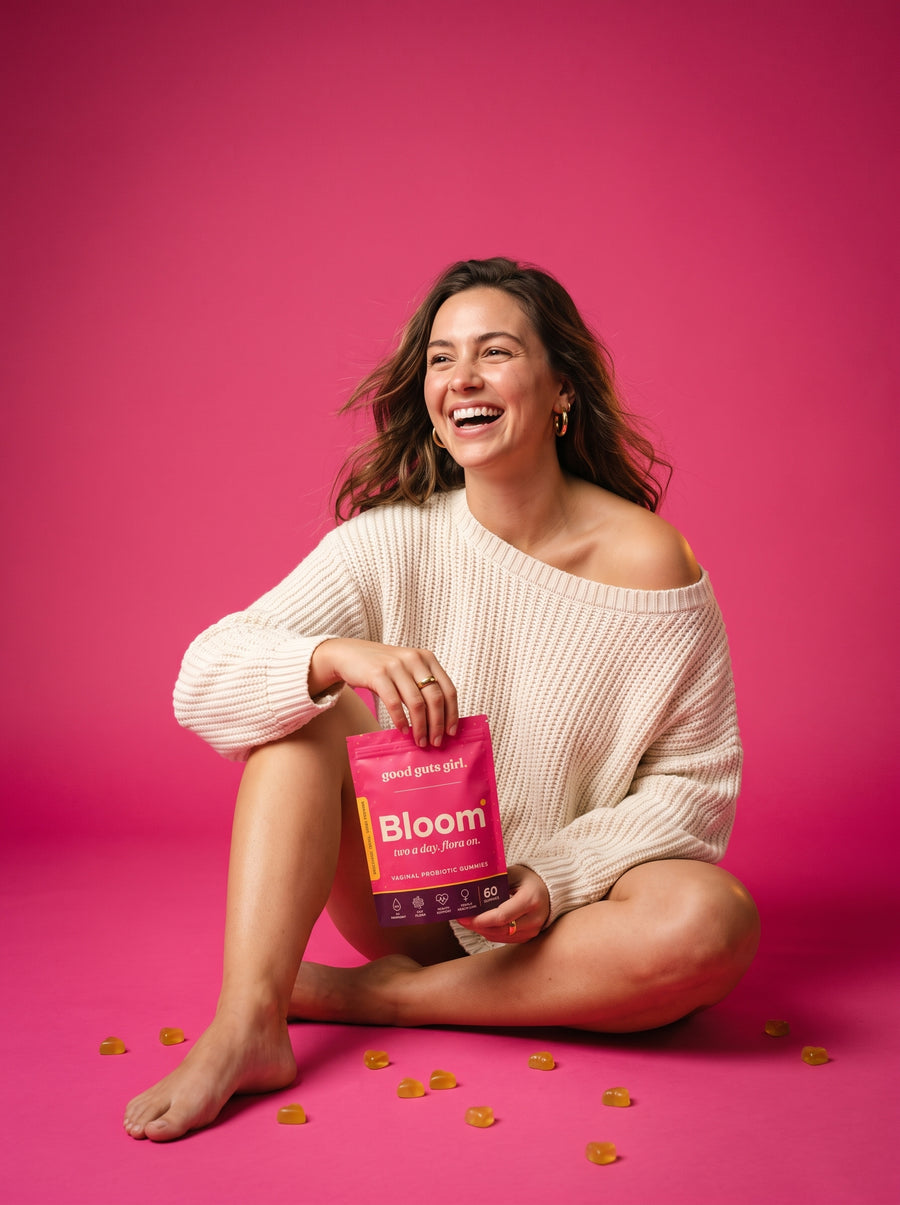
Good Guts Girl Bloom vaginal probiotic gummies
good guts girl — Bloom
★★★★★ 4.9 · founding member beta
The daily gummy this article ends up at: a spore-forming probiotic built to restock what a course of antibiotics clears out. $29.99 founding price, 60-day guarantee.
See Bloom →
✓ 60 days, feel it or it's free · free US shipping over $40

Or keep reading — reasons 1 to 4 are why nothing has held so far.

Reason 01

Antibiotics reset the system. Nothing in the prescription restocks it.

A healthy vaginal environment is acidic — roughly pH 3.8 to 4.5 — and it is held there by good bacteria, lactobacilli, producing lactic acid. That acidity is the security system. It is not a state your body simply has; it is a state a living population maintains, every day.

Metronidazole does not read name badges. It clears bacteria — the ones causing the problem and the ones holding the line, together. So you finish the course with the infection cleared and the security system switched off. An empty shelf.

And an empty shelf does not stay empty. Whoever arrives first, wins. The bad bacteria multiply faster than lactobacilli rebuild. That is the whole cycle, in one sentence.

>50%
see BV return within a year

Recurrence after a standard course is the norm, not the exception — the majority of women see BV return within twelve months, and for many it is within weeks. You are not the outlier. You are the pattern.

The words you probably already used"They only suppress it and the infection comes back." Women describe this to each other far more accurately than the aftercare leaflet does. Suppress is the right verb. The drug clears; it was never designed to hold.

The most upvoted comment in one of the largest recurring-BV communities puts it more bluntly than any leaflet ever will:

"Gynos give antibiotics for everything. It kills the bad bacteria and obviously the good too. If our flora is corrupted, there is no antibiotic that will cure BV."— top comment, recurring-BV community thread

She is not anti-medicine and neither is this article. She has simply worked out, from her own repeated experience, that clearing and restocking are two different jobs — and that she has only ever been given the first one. The second job is what a daily probiotic is for, and it is the one nobody hands you on the way out.

Reason 02

For a lot of women, antibiotics did not just fail to fix it. They started it.

Read any recurring-BV thread and one origin story appears over and over, almost word for word: "It's all because I was on antibiotics for a UTI, and now this."

Ten days of a broad-spectrum antibiotic for a urinary tract infection does its job in the bladder and clears out the lactobacilli on its way through. The UTI goes. Two weeks later something else shows up — and because nobody connects the two events, it gets filed as a new, separate, unlucky problem. It was not a new problem. It was the bill for the last one.

The same thing happens after a course for a chest infection, a dental abscess, or acne. If you can point to the exact month it all started and there was an antibiotic in that month, you have almost certainly found your answer.

Why this matters more than it soundsIf antibiotics started it, then more antibiotics cannot be the whole solution — you would be treating the problem with its own cause. That is not an argument against taking them when you need them. It is an argument for doing something afterwards that nobody ever tells you to do.
Reason 03

"It'll settle down on its own" — the sentence that costs women years.

Almost every woman in this situation has been told some version of it. It'll clear up. Try a different soap. Wear cotton underwear. Reduce your stress.

To be fair to the people saying it: an appointment is seven minutes long, a prescription resolves the acute complaint, and nothing in that system is designed to manage what happens in week three. The advice is not malicious. It is just aimed at the wrong thing — your habits, rather than the population of bacteria that got wiped out.

But the cost lands entirely on you. Two years of assuming you must be doing something wrong. Changing detergent. Quietly deciding that your body is just like this.

Which is how women end up where these threads end up:

"The gynecologists don't care. I'm over doctors. I've tried multiple antibiotics over the years and nothing has worked."— recurring-BV community thread

That is exhaustion talking, and it is aimed at the wrong target — your doctor is the right person to clear an episode, and you should keep seeing them. But she is right about the gap she has fallen into. Nobody in a seven-minute appointment owns what happens in week three, so it lands on her, undefined, every single time.

You were not being difficult, and you were not imagining the pattern. You were describing it accurately to people who were answering a different question.

Reason 04 — the one that explains the rest

It is not coming back. In many cases it never fully left.

This is the reason that reframes every failed round, and it explains the timing that makes women feel like they are losing their minds: full course completed, symptoms genuinely gone for a few days, and then it returns almost on schedule.

Certain bacteria involved in BV do not just float around loose. They build a biofilm — a dense, sticky layer that adheres to the vaginal wall and shields the bacteria living inside it. Think of it less as a crowd and more as a settlement with a roof on it.

Antibiotics are extremely effective against free-floating bacteria. They are far less effective at reaching what is sheltering under a biofilm. So the course does what you saw it do: it clears everything exposed, symptoms disappear, the test comes back clean. What survives is what was protected. And the moment the drug is out of your system, the protected population starts repopulating a space where the good bacteria have just been cleared out too.

That is not a relapse. That is regrowth from a foothold that was never touched.

Which means it was never about how clean you are, how careful you are, or how well you followed the instructions. You cannot out-hygiene a shielded population.

Here is the part worth sitting with: women in recurring-BV communities figured this out on their own years ago. "It's the biofilm" gets posted constantly — by women, to each other, without a single doctor in the thread. They were ahead of the advice they were being given.

2 jobs
not one

Which is why breaking the cycle is two jobs, not one. Interrupt the shield. Then rebuild the population that keeps the pH low enough that it cannot re-establish. Antibiotics do neither of those things — and nothing else in the prescription does either.

Hold on to those two jobs, because they are the whole test from here. Anything worth your money has to do both — which, as it happens, is exactly why the gummy further down this article has three ingredients rather than fourteen. One interrupts. One rebuilds. Nothing in it is there to pad out a label.

So what actually does those two jobs?

"It's not your fault" is a comforting sentence and a useless plan. The next round is still coming, and your microbiome does not care how well you now understand the mechanism.

Which brings us to reasons 5, 6 and 7 — the three that are actually within your control, and the one almost everyone gets wrong on the first attempt.

Bloom vaginal probiotic gummies
good guts girl — Bloom
★★★★★ 4.9 · founding member beta
The daily gummy behind reasons 5–7. Founding price $35 $29.99 · 60-day guarantee.
See it
Reason 05

You were right that the drug was wrong. You are also right that the next one won't hold either.

There is a very specific frustration that comes from rounds of metronidazole doing nothing, and then a specialist finally prescribing clindamycin — and that one working. It is a genuinely useful thing to know, and it is worth raising with your doctor if you have had repeated courses of the same drug with no result.

But notice what that story actually proves. It proves the right antibiotic clears it better than the wrong one. It does not prove any antibiotic keeps it gone — because none of them restock what they clear, and none of them stop the shelf from being empty afterwards.

So the enemy was never really the specific molecule. Getting the right one shortens the misery of an episode. Keeping it from coming back is a completely different job that no prescription is written for.

The distinction worth keepingClearing an episode is your doctor's job, and a good one. Holding the environment afterwards is a daily job — and it is yours, because nobody has been giving it to you.
Reason 06

You have been buying solutions in emergencies — which is why none of them got long enough to work.

Count the rounds, if you can. Most women in year three or four have genuinely lost track, and almost nobody wants to add up what it has cost: the appointments, the prescriptions, the boric acid, the tests, the two or three things bought at 1am that are still in the bathroom drawer half-used.

"I've had this for years and I don't even want to add up what I've spent. I'm honestly at the point of frustration."— recurring-BV community thread

But look at the shape of that spending, because it is the reason it never adds up to anything. Every one of those purchases happened during a flare. You buy in the bad week, you take it while it is bad, and once things settle you stop — because who keeps taking something for a problem they do not currently have?

So nothing you bought ever got a fair run. Not because it was the wrong thing, necessarily, but because you were treating a maintenance problem with emergency behaviour. And the flare is precisely the moment when it is already too late to start.

The reframe worth keepingYou do not have a series of infections. You have an environment that keeps losing its defences, and each flare is a symptom of that. The thing that fixes it is boring, cheap and daily — and it has to be running before the bad week, not during it.

Which is the entire argument for something you take every morning without thinking about it, at a price that does not make you weigh it up each time. Roughly a dollar a day, and less than a single appointment — that is the whole point of the format.

Two gummies taken every morning as a daily habit
The version that works is the unremarkable one — taken on an ordinary morning, months before the next bad week.
Reason 07

Why it has to be daily — and why the format decides whether it works at all.

An oral probiotic works through the gut–vaginal axis: it establishes in the gut first, then migrates and colonises. That takes roughly two to four weeks, which is why "I'll sort it out next time it flares" is the one plan that structurally cannot work. By the time there is a next time, you needed to have started a month ago.

The best time to start was after your last course of antibiotics. The second best time is today.

And it has to be daily, because the population gets knocked down continuously — your cycle, sex, stress, and every future antibiotic you will ever be prescribed for something completely unrelated.

Which is where almost every product in this category quietly fails. Not on the science — on the taking of it. A horse-sized capsule that lives in the fridge gets taken for eleven days. Eleven days of a twenty-eight-day process is nothing at all.

That is the entire reason Good Guts Girl built Bloom as a gummy. Two a day, sugar-free, shelf-stable, on the nightstand instead of hidden behind the vitamins. The supplement that works is the one you still take on day nineteen.

Before you decide

Two things you are probably thinking right now.

"I've tried a probiotic before and nothing happened."

Then it is worth knowing what most likely went wrong, because it probably was not you and it probably was not the idea.

Standard lactobacillus probiotics are living, fragile bacteria in a capsule. They have to survive a warehouse, a shelf, your kitchen cupboard, and then stomach acid at roughly pH 1.5 to 3.5. Estimates put survival through that gauntlet at somewhere around 1 to 10 percent. That "50 billion CFU" on the label describes what went into the capsule at the factory — not what makes it out the other end.

Spore-forming strains are built differently. Bacillus coagulans grows its own protective shell — a spore — which is why it survives heat, shelf storage and stomach acid, then activates in the gut. It is the same reason it does not need a fridge. One billion that arrive beats fifty billion that don't.

"Everyone online says it has to be a crispatus suppository."

This comes up constantly, and it is not a silly belief — L. crispatus really is associated with a stable vaginal microbiome, and a suppository really does put bacteria directly where you want them.

Two honest caveats. First, direct delivery does nothing about the gut, which acts as a continuous reservoir — which is why an oral route matters even if it sounds like the long way round. Second, and less scientific but more decisive in practice: suppository regimens are the ones women abandon. They are messy, inconvenient and expensive, and consistency is the entire mechanism here.

This is not an argument against ever using one. It is an argument for having a daily habit underneath it that you will still be doing in week nine.

Spore-forming strain built to survive stomach acid
Spore-forming B. coagulans carries its own shell — which is how it survives the shelf and the stomach.
$35 Start my 30 days — $29.99
✓ 60-day money-back guarantee · ships in 1–2 business days · free US shipping over $40
What's actually in it

Three ingredients. Two jobs. No proprietary blend.

Most supplements in this aisle are fourteen things hidden behind the words "proprietary blend." Bloom has three active ingredients, and each one is there for a reason you can now name.

1. Bacillus coagulans SKZ1969™ — 1 billion CFU

The restock

The spore-forming strain. Survives the shelf and the stomach acid, arrives alive, and produces lactic acid — the same mechanism your own lactobacilli use to hold that protective acidic pH. This is the job antibiotics leave undone.

2. Pineapple fruit powder — 100mg

The reason it can hold

Not for flavour. Pineapple contains bromelain, and emerging research suggests bromelain enzymes may help disrupt biofilm — reason 4, the thing antibiotics struggle to reach. Research also indicates B. coagulans metabolites inhibit biofilm formation. Both are in this gummy. Nobody else in the category is doing that.

3. Vitamin C — 20mg

The foundation

Supports immunity and the mucosal tissue where all of this is happening. Unglamorous, and the reason the other two have somewhere stable to work.

Good Guts Girl Bloom
good guts girl

Bloom — the daily habit that starts where the prescription stops.

★★★★★ 4.9 from founding member beta

Two gummies every morning. Sugar-free, ten calories, no fridge. 1 billion CFU spore-forming B. coagulans + bromelain + vitamin C.

Built for the woman who is done treating this as an emergency three times a year, and would like it to become something she simply handles.

Claim founding price →

Where each thing you've tried actually stops

Bloom Antibiotics Standard capsules Suppositories
Clears an active episode that's the job
Restocks good bacteria daily ✗ clears both sides If any arrive alive direct
Survives stomach acid spore-forming n/a ~1–10% survives n/a
Addresses biofilm bromelain Struggles to reach it
Still doing it in week nine two gummies Short course only Usually abandoned Usually abandoned
Fridge-free · 0g sugar

The antibiotics column describes factually what a prescribed course is designed to do. Bloom is a daily supplement to use alongside whatever your doctor recommends — never a replacement for treatment. If you have symptoms, see a healthcare professional.

Start the part antibiotics skip
✓ 153 founding spots left · $40 founding kit free with every order

Comments (186)

Community guidelines: be kind, no medical advice.
JL
Jenna L. · 4 days ago

reason 2 is literally my whole story. UTI in january 2024, antibiotics, and I have not had a normal month since. nobody ever once mentioned the two might be connected. I genuinely thought I'd just become a person who gets this now.

TM
Tori M. · 4 days ago

same but mine was for a tooth infection. five years of thinking it was stress.

HB
Hannah B. · 3 days ago

finished the course, felt fine for four days, smell was back by day six. every single time. reading #4 was the first time that timeline has ever made sense instead of feeling like my body was broken.

S
Sasha · 3 days ago

going to be the sceptic here. I've already spent about $400 on probiotics, boric acid and suppositories. why is a gummy going to be different

DK
Dani K. · 2 days ago

@Sasha fair, I was the same. the difference for me was honestly just that I kept taking it. I have a drawer of half-finished capsules from three different brands. week three-ish something shifted and I'm on my third pouch now. the 60 day thing is what made me risk it.

MR
Megan R. · 1 day ago

the biofilm section. I brought this up with my gyno two years ago after reading about it on reddit and got a look like I'd been on webmd too long. nice to see it written down properly.

60 days — feel it or it's free

Sixty days. Feel it, or it's free.

The research says two to four weeks to colonise, so we give you sixty days to judge it properly — long enough to see whether the pattern actually changes, not just how the first week feels.

If nothing has changed, email us and we refund every penny. You keep the pouch. No form, no return label, and nobody asks you to explain yourself.

You have already paid for rounds of things that didn't hold. This is the one where the risk is ours.

Founding member pricing

Choose how long you want to stop thinking about it.

⏳ First 500 women only — 347 claimed, 153 left
1 pouch
30 days · try it
$35
$29.99
save 14%
3 pouches
90 days · the cycle, broken
$105
$69.99
save 33% · $23.33/pouch
Subscribe & save: $24.99/mo · skip or cancel any time
Everything you get — $40 founding kit free
🎀 Every founding order ships with the $40 welcome kit — handbook, 28-day tracker + cheat sheet — free

Two gummies a day, so the next course of antibiotics isn't the start of another six months.

60-day guarantee ships in 1–2 days free US shipping over $40 0g sugar

The questions women ask before they order

Can I take it while I'm still on antibiotics?

Most women start the day they finish the course, which is when the shelf is emptiest. If you want to take both at once, space them a few hours apart and check with your prescriber — spore-forming strains are more robust than standard probiotics, but your doctor knows your situation and we don't.

How long before I notice anything?

Colonisation through the gut–vaginal axis takes roughly two to four weeks, so judge it at week four, not week one. That's exactly why the guarantee runs sixty days instead of thirty.

Is this instead of seeing my doctor?

No, and please don't treat it as one. An active infection is something a healthcare professional should look at. Bloom is a daily supplement for the part that happens afterwards — the part no prescription covers.

Why a gummy? It sounds less serious than a capsule.

Because adherence is the mechanism. A capsule regimen abandoned on day eleven delivers nothing, and a twenty-eight-day process needs twenty-eight days. Sugar-free, ten calories, and it stays on the nightstand instead of the back of a cupboard.

I've tried probiotics before and nothing happened.

Then the "before you decide" section above is the one to reread. Standard lactobacillus capsules lose most of their dose to stomach acid before it ever arrives. Spore-forming B. coagulans is built for that trip. And if it still does nothing for you, sixty days, every penny back, keep the pouch.

★★★★★ 4.9 $35$29.99 · Bloom Claim founding price